When prosecutors, Brady risk, and real research collide with AI hype, the question isn’t “Will AI write my reports?” It’s “Who still owns the story when the case hits the courtroom?”

We’ve been hearing a lot of big promises about the benefits of AI in Public Safety Software lately. As an agency administrator, you’re already short-staffed, already buried in NIBRS and mandate work, and hopefully a little skeptical of “vendor magic.” It seems a lot of vendors have rushed to be the first in the market with fancy AI tools, and while there is hopefully some promise in that future, it’s important to stay connected to the purpose your agency serves in your community, and the role that incident reports play in that.
Perhaps it’s lost on some these days, but the part of the report that actually matters in court isn’t the dropdowns. It’s the narrative. Your officer’s words. What they saw, what they did, what they decided. That’s the piece a DA reads, a defense attorney picks apart, and a jury hears when someone says, under oath, that the report is accurate.
The hype is loud. The evidence is quieter.
We’re seeing a lot of tools that can draft a narrative for the officer, often from body-worn camera audio or similar inputs. The pitch is usually some version of “get your people back on the street faster.”
Some agencies are seeing success with these tools. Others are finding they’re not all they’re cracked up to be.
In a pre-registered randomized controlled trial with the Manchester, New Hampshire Police Department, researchers (Adams and colleagues, published in the Journal of Experimental Criminology) tested AI-assisted report writing against traditional writing. Result: no statistically significant reduction in report-completion time. Officers still had to read, fix, cut, and add. In the discussion, the authors note that even if tools can streamline narrative writing, that may not cut total report time much, because “the bulk of police report writing involves meticulous data entry and documentation of various aspects of an incident that AI may not yet be equipped to manage efficiently.” That data-entry grind (NIBRS and related objects) is exactly where we think AI can help most.
Some courts aren’t buying “AI wrote it”
Accuracy and ownership aren’t abstract ethics problems. They’re case problems.
In September 2024, the King County Prosecuting Attorney’s Office told local law enforcement it would not accept police report narratives produced with AI assistance. The concern wasn’t “we hate technology.” It was hallucinations, unnoticed errors, and what happens when an officer on the stand swears a report is accurate, and then has to explain a detail the AI invented (including, in one example cited publicly, an officer who wasn’t even on scene). That’s how you get Brady headaches, credibility damage, and cases that wobble for reasons that had nothing to do with the original call.
A June 2025 Fair & Just Prosecution brief hit similar themes of accuracy, accountability, privacy, and discovery risk when a machine-generated story enters the record.
You don’t have to agree with every brief’s framing to hear the operational point: if your DA won’t take the narrative, the tool isn’t helping your agency.
Again, I want to be clear that some agencies are having success with these tools. Major innovations in LE technology have always been met with resistance and skepticism. But wise administrators are asking:
- Does my prosecutor accept it?
- Can my officer defend every sentence?
- Is there a clean audit story when discovery hits?
EFORCE’s stance is not that we’re “anti-AI-generated narratives,” but we also see that a lot of the common criticisms are starting to surface substantive findings. We agree with what recent studies are producing: AI is not well suited for generating police report narratives.
Keeping an “officer-in-the-loop”
You’ll find that most responsible companies using AI are doubling down on the “officer-in-the-loop” position, and for good reason. The point of any of these tools is to improve your effectiveness and efficiency. But at this point, AI is simply not able to be trusted when people’s freedom and rights are at stake.
It’s important to find a solid balance between empathy and efficiency:
- The officer still owns the narrative. This isn’t a marketing promo piece, or a homework assignment. We’re dealing with major consequences for real people, and that deserves a human touch.
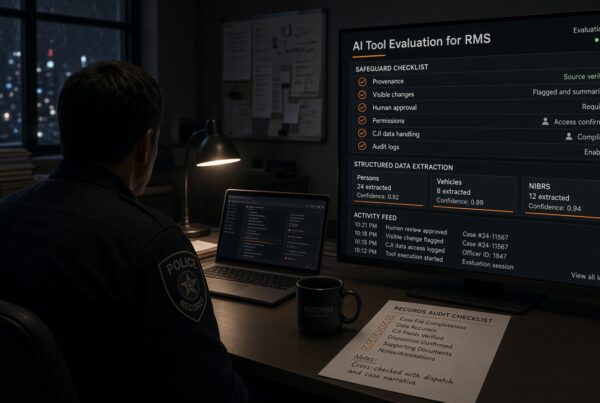
- AI is an assistant to help with the “bean counting.” NIBRS fields and objects in the narrative (like persons, vehicles, and property/evidence objects) can be extracted to reduce duplicate entry and other tedious, repetitive tasks. Of course, human approval is key to ensuring accuracy, but the opportunity/risk for hallucination is much lower.
- The help lives inside the CAD/RMS/Mobile workflows your people already run, not as another bolt-on login, another training curve, and another browser tab fighting for attention after a long call.
- A human reviews before it becomes the official record, same reason supervisors approve reports today. Hallucinations are unacceptable in something that might end up in front of a judge.
Where EFORCE® fits
We’re huge proponents of AI and what it can do now, and what it will be capable of into the future. We just also believe that law enforcement deserves tools that are focused on their needs, not providing tools to say we have them.
We do not use AI to generate or draft narratives for officers. It’s the most important part of the incident, and we believe that a human should always be responsible for it.
In EFORCE®, AI reads an officer’s already written incident narrative and helps extract structured data for NIBRS reporting, as well as objects like persons, vehicles, and property/evidence. That’s the meticulous data-entry work the Manchester study discussion points to as the bulk of report time, and it’s the problem our AI is focused on solving.
We think NIBRS and object extraction is a better use of the tech for most agencies, especially when prosecutor and court acceptance of AI-authored narratives is still unsettled.
If your agency already successfully uses a separate narrative-drafting tool, we can still play ball with them. Regardless of its source (direct from an officer, or from an AI assistant), once it’s in our system, EFORCE® helps with the structured extraction.
We’re not going to pretend our process deletes report writing. We’re not going to promise a stopwatch miracle the research doesn’t support. But we will say that our company is focused on addressing your agency’s operational headaches, and streamlining your processes.
How to evaluate AI reporting tools without getting burned
If you’re comparing options, or writing policy, use a checklist that matches how your agency actually gets sued, audited, and staffed:
- Who writes the story? If a tool drafts the narrative, what’s your DA’s position?
- What’s the error mode? Hallucinated data, wrong times, softened force language, missing exculpatory detail? Who catches it, and how?
- Where does the work happen? Inside your existing CAD/RMS/Mobile flow, or as a bolt-on that creates another login and another place for data to fall through the cracks?
- What’s claimed vs. what’s measured? Ask for evidence beyond officer surveys. The Manchester study is a useful reality check on time-savings claims.
- What’s the disclosure story? If AI touched the file, can you explain that cleanly in discovery without looking like you’re hiding the ball?
What matters is whether this helps your people survive the next audit and the next jury. We recommend that you rigorously test any vendor’s claims, including our own.
Bottom line
AI in police reporting isn’t going away. Reporting mandates aren’t either. The agencies that stay out of trouble will be the ones that keep humans accountable for the narrative, take prosecutor and court acceptance seriously, and use AI where it’s actually useful: helping extract NIBRS and related objects inside tools officers already know and trust.
If you want to see how EFORCE® puts that into practice, take a look at EFORCE® AI, or call 888-570-4943 x.3 / [email protected]. We’d love to give you a demonstration of how our products can help your agency.