How to find tools that fit your agency’s needs and improve your goals.
There’s a lot of buzz in the public safety space right now about AI tools. Some people think AI is a magical panacea that’s going to solve all the world’s problems, and others think it’s going to cause the end of the world.
But like I’ve talked about in other articles, the reality of AI is that it’s here to stay, and it’s going to find a place within your agency’s day to day operations. The question agency administrators are now asking is, “How do I implement these tools safely?”
This guide is designed to help you understand what kinds of AI exists, and how you can implement it at your agency in a way that protects public privacy, officer safety and case integrity.
What kinds of AI show up in RMS and Incident Reporting?
Two different jobs get sold under “AI reporting.” Knowing which one you’re buying changes your risk, your training, what you tell your DA, etc.
Narrative generation drafts or rewrites the officer’s story (often from notes, CAD, or body-worn camera audio). Usually, an Officer is asked to review/approve the produced draft.
Extraction / structuring reads a narrative and helps populate structured fields and objects (NIBRS elements, persons, vehicles, property/evidence), with officer review/approval before applying changes.
Both tools help Officers do less work, but they have vastly different outcomes. Many agencies are growing skeptical of vendor claims of time savings by writing officer’s narratives for them. Other agencies are seeing push back from their prosecutor’s offices about using those tools in court. For the longer take on narrative ownership and officer-in-the-loop technology, see Officer-in-the-Loop: Keep the Narrative Yours.
What are my priorities?
Public Accountability: As you well know, your agency is held accountable by the public you serve for the tools you use to protect them. There are some notable recent examples of citizen push back on AI tools. *(cough) Flock (cough)*. I’ll refrain from sharing my personal thoughts, but suffice it to say, despite several OBVIOUS public safety benefits, the public is concerned. New can be scary. If you serve a jurisdiction that has pushed back on these kinds of things, you may want to consider that before spending a bunch of money.
Solving Problems without Creating More: Agencies that successfully deploy new tools also consider the impact that these tools will have on the viability of their cases in court. Look at GPS devices for narcotics teams. If you can’t use what you know, it doesn’t matter. With AI, if the prosecutor/courts won’t let you use the results of the tool, it doesn’t matter how efficient it is. Understanding the problems this tool will solve, and the problems it might create, are import.
CJIS Compliance: Your agency is responsible to protect the data you hold. As stupid as the Security Awareness Training courses are, the consequences of not securing that data are real. AI can pose a significant risk to security if not implemented correctly. That turns into an expensive fix to regain CJIS compliance and potentially wasted money on a tool you can’t use.
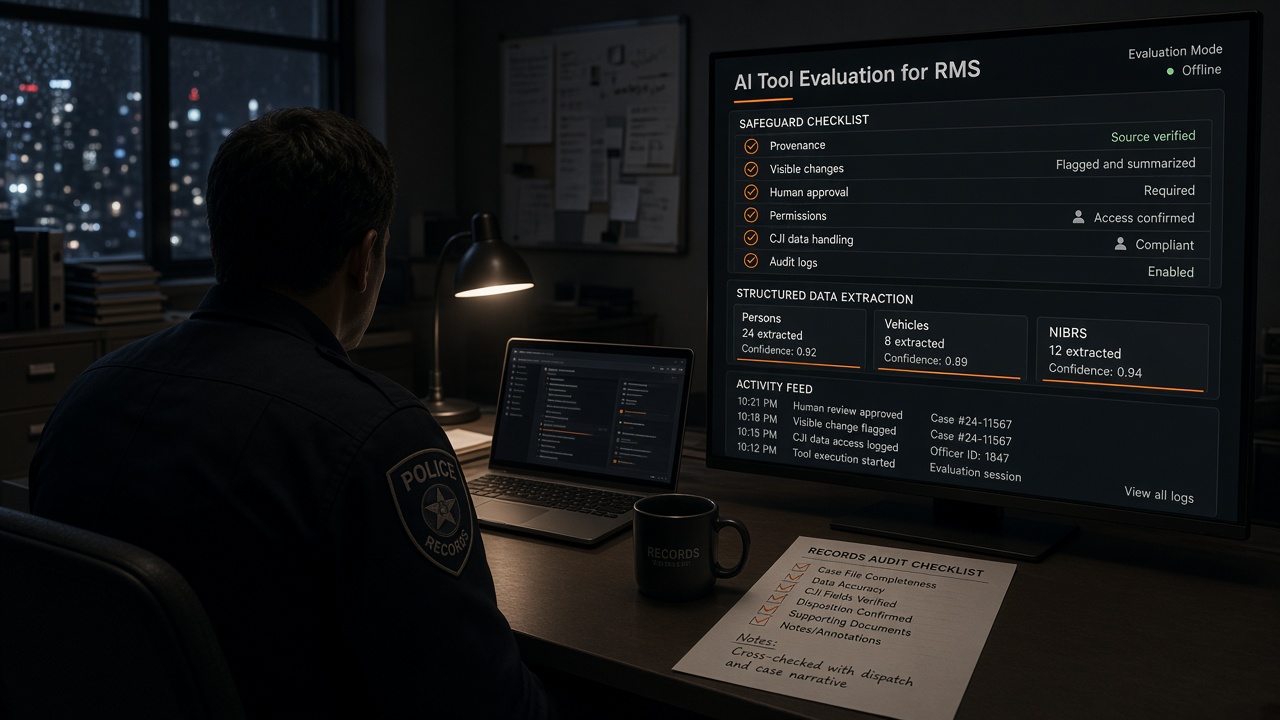
Six questions that protect those priorities:
As you are demo’ing products and reviewing tools, use these as overrules in every demo. If a vendor cannot answer them in plain language, you might want to keep looking.
- Where did the AI get what it generated? Can it show the source of its information (officer narrative, CAD, BWC transcript, prior RMS fields, or something else)?
- What did the AI change? Does it show the user every suggested change before anything becomes official?
- Who approved the result? Does it record the user who accepted the output?
- Who can use the AI? Can admins set permissions so only the right people can run it?
- What happened to the data? Can the vendor demonstrate that Criminal Justice Information (CJI) is not shared outside authorized systems or used to train public models by default?
- Can the tool be audited afterward? Can your agency review these items after the fact when questions arise about specific incidents?
Questions 1 through 3 mostly protect case integrity and empowerment (humans still own the record). Questions 4 through 6 mostly protect CJIS / agency control. All six support public accountability, because you can explain what the tool did and who signed off.
A practical evaluation checklist
Use this as a scorecard in demos and procurement. Adapt to your state. Your TAC and state CJIS Systems Agency own the final compliance call.
Agency Evaluation Toolkit
Evaluate AI tools for RMS
Open a section, mark each criterion, and export the gaps.
- Fill agency, vendor, and evaluator. Go through the questions with the appropriate personnel from your agency.
- Mark each question with the appropriate level: Met, Partial, etc. Use notes for relevant info.
- Treat Partial as promised, not shown.
- Copy the gap list before anyone leaves the room.
Open Gaps
Items marked Not met or Partial.
No gaps yet — open a section and score the criteria.
Where EFORCE® fits
In EFORCE® AI, AI reads an officer’s already written incident narrative and helps extract structured data for NIBRS reporting and other objects like persons, vehicles, and property/evidence. Officer review stays in the loop before anything becomes official.
We build for agencies that want AI to make the paperwork load more efficient while officers keep ownership of the story and admins keep control of the system. We are a fan of careful AI for operational problems. We encourage you to test our claims the same way you test everyone else’s.
If you would like to see our AI in action, you can request a demo in any of the following ways:
- https://www.eforcesoftware.com/request-a-demo/
- 888-570-4943 x.3
- [email protected]
FAQ
How do I implement AI tools safely at my agency?
Start with these three priorities: public accountability, solving problems without creating court or credibility problems, and CJIS / data security. Then run the six evaluation questions and the checklist above before you buy.
What kinds of AI exist for RMS and reporting?
Broadly: tools that draft or rewrite narratives, and tools that extract structured data from narratives. Ask for details about what a tool does, and how it does it.
What should we ask before we trust an AI police report draft?
Demand provenance (where it came from), visible changes, recorded human approval, admin permissions, a clear CJI / no-external-share story, and audit logs.
Did research show AI writing narratives saves time?
The Manchester NH RCT found no statistically significant reduction in report-completion time for AI-assisted writing. We encourage you to evaluate any specific vendor claims of time saving for yourself.
Is “CJIS certified AI” a real credential?
No. Compliance is how your agency and systems handle CJI under the Security Policy, with your state auditor as the authority that matters. Even tools that comply with the requirements of the CJIS Security Policy will still need to be evaluated against your agency’s policy and configurations.
Should AI replace officers writing reports?
No. Look for tools that empower officers and records staff to work more efficiently while your agency stays in control of permissions, data, and what becomes the official record.